
Export Process in Sri Lanka
The export process consist of few steps as follows,
Step 01- Register as an exporter in Inland Revenue Department.
The person who is willing to export any articles of commercial value from Sri Lanka should register as an exporter in Inland Revenue Department and Sri Lanka Customs.
Step 02- Get licenses and permits from relevant institutes according to the product you willing to export.
There are different types of certificates and relevant authorities vary from product to product. Some of the products, certificates and relevant authorities as follows,
Step 03- Create PRO-FORMA INVOICE.
A pro-forma invoice is a preliminary bill or estimated invoice which is used to request payment from the committed buyer for goods or services before they are supplied.
You can create this invoice by including below details.
- Product details.
- Quantities.
- Prices.
- Terms of payments (advance payment, letter of credit, documentary collection, open account, and consignment account).
- Goods transport conditions (FOB/CFR/CIF).
- Packaging details.
Step 04- Sending trade samples.
The foreign buyer may ask about sample of the product before trade transaction occurred. Samples are usually sent by airmail to avoid delays. However, sample of gems and jewellery are not permitted to send.
Step 05- Packaging.
The exporter should ensure that packages are properly packed, and packages has been done according to the buyer’s requirements, and packages should load which facilitate to inspections of custom.
Step 06- Reservation of CARGO space.
Sea CARGO
The exporter should meet a shipping agent to get reserved shipping spaces. Then the exporter should submit the shipping note to the shipping agent.
Air CARGO
In this process, the exporter should check with the airline agents servicing where the country is concerned. The exporter should submit the document called shippers instructions for dispatch. Ultimately, this document will use to issue the airway bill.
Step 07- Per cent certificate required for exports.
- Certificate of origin (GSP certificate).
- Health certificate.
- Phytosanitary certificate.
- Pest control certificate.
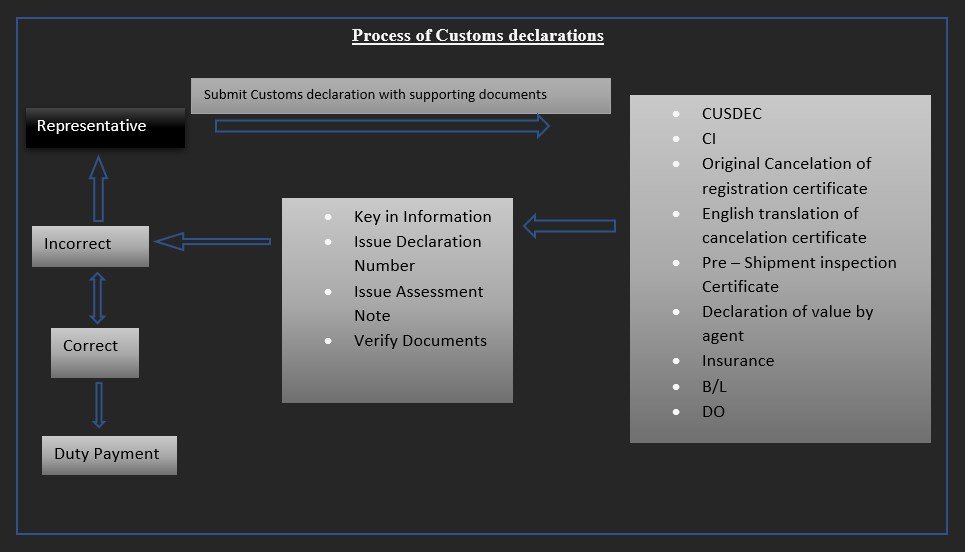
Step 08 - Comply with the customs procedures.
In this step, the exporter should follow these three sub-steps.
1. Making Customs Declaration.
Exporter should prepare few important documents to make Customs Declaration, those documents are as follows,
a. Customs Goods Declaration (CUSDEC).
This declaration is very much important because international trade is the exchange of goods & services across borders or territories. All the details of the commodities should be present in this process.
b. Commercial Invoice.
An invoice is a document prepared by the Exporter including all the details regarding the shipment.
c. Packing List.
This document specifies the contents of each individual package in the shipment.
d. Other Documents (if applicable).
- Any Permits/License.
- Tea Blend Sheets.
- Material Safety Data Sheet.
e. Direct Trader Input (DTI).
By using this method exporter can complete the full custom process remotely.
2. Pay Export Duty & Cess Charges.
The exporter should pay relevant fees to the custom.
3. Face Customs Examination.
The Examination is carrying out at the exporter`s premises or warehouse or container freight station.
Step 09 - Implement the Port procedures.
In this step, the buyer should pay port charges to the Finance Division of the Sri Lanka Ports Authority and should move the Cargo to the Port. At this time buyer should be prepared and submitted the shipping note and Cargo dispatch note.
Step 10- Submit the documents to the commercial bank.
- Commercial invoice Original Bill of Lading /A.W.B. No.
- Insurance Policy (if on CIF).
- Bill of Exchange (If on D/P or D/A terms).
- Letter of Credit.
- Certificate of origin / GSP Certificate.
- Packaging List.
Test